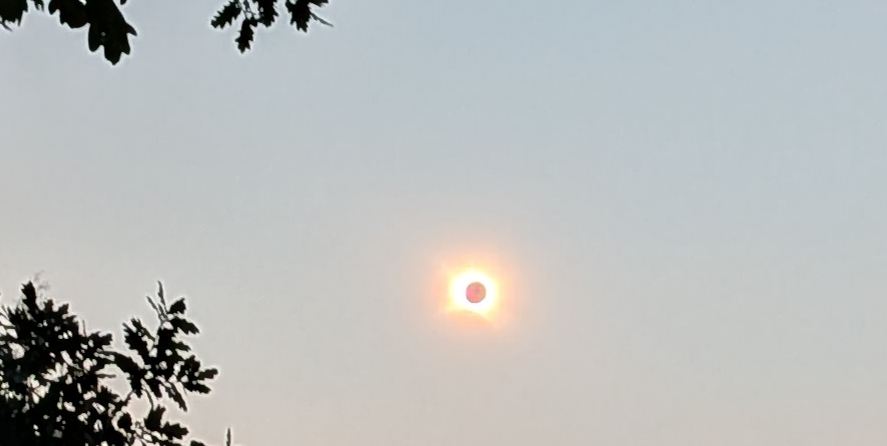
This summer’s moment of Zen was a bit different: instead of watching a cycle of tides, we went in search of cloudless skys to watch a total eclipse and that lead us to a “castro” (an Iron Age fortified hilltop settlement).
Disclaimer: there are no amazing images or videos of the eclipse as I was busy being in the moment for the 1 minute 29 seconds of totality and did not want to be fighting with technology. This was a good idea because the one picture I took is above and it in no way captures how crazy amazing and mind blowing totality is.
read on for more!
August 12, 2026 Eclipse
I have known about the 2026 summer eclipse for a few years now, and have been excited about it from the beginning as totality crossed over the town my wife was born in and where we happen to be almost every August. The only problem with the northern Spanish coast is that sun is not a guaranteed luxury.
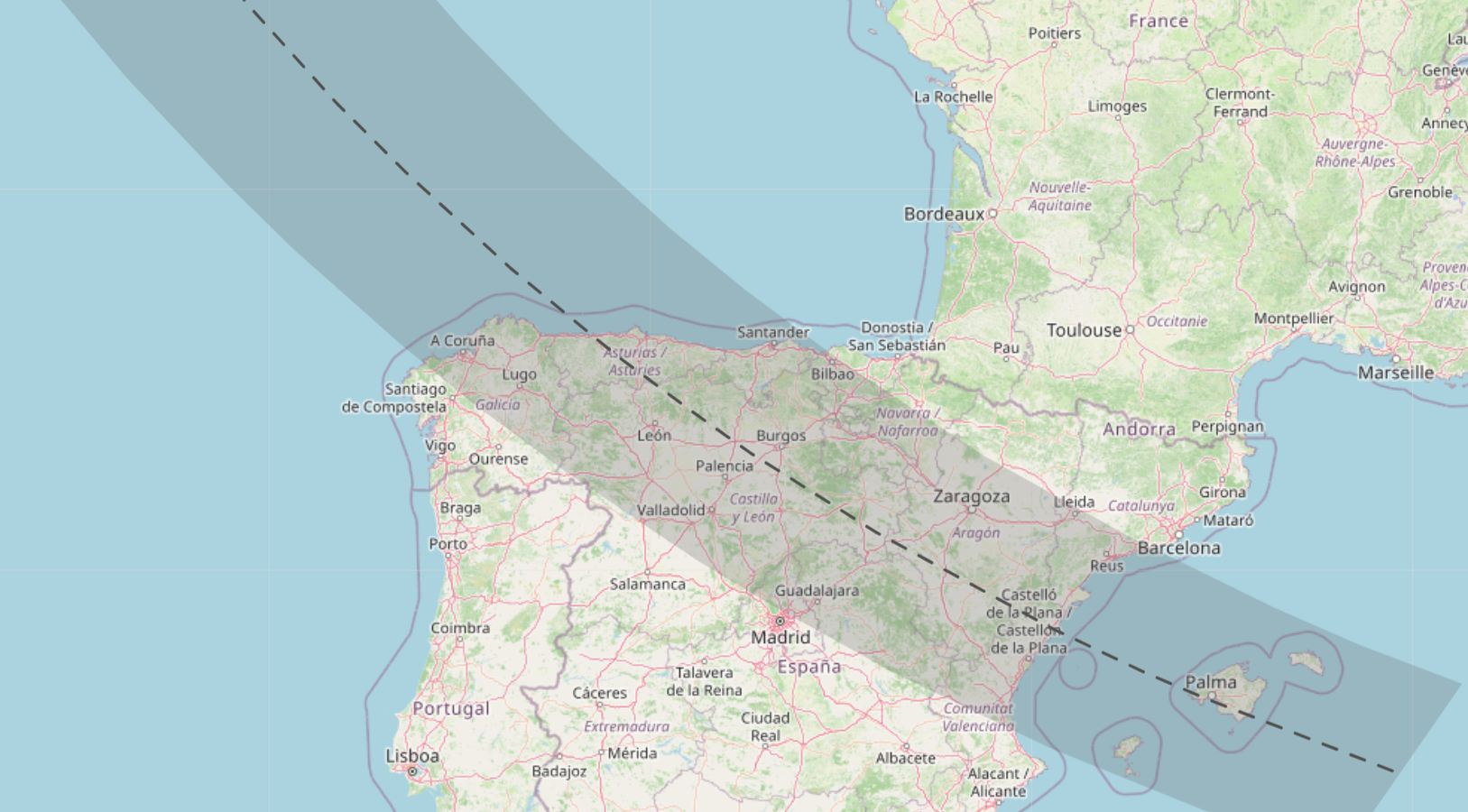
We arrived here on Monday before the eclipse (scheduled for Wednesday), and both Monday and Tuesday were cloudy in the morning, but sunny in the afternoon. On Tuesday afternoon I scouted out the primary watching location which happened to be last year’s moment of Zen to make sure everything lined up, which it did.
The only problem is that when we woke up on Wednesday morning the clouds were much thicker than the previous two days and did not look like they would burn off, and all of the weather prediction sites concurred that it would be cloudy all day. Oh no. Mad dash to find a plan B. Claude helped out a lot finding a very cool site with all sorts of recommended sites that had good visibility provided there were no clouds. But one site that was not listed that was inland and by my calculations most likely out of the cloud belt was Castro de Viladonga.
Tangent about Castro Villadonga
I have pretty much spent some part of every summer in Ribadeo since 1997 and from the first visit there was talk of a visit to an amazing castro between Lugo and Ribadeo called Castro Viladonga. The problem is that Ribadeo is very sticky in the sense once you are here it is very hard to leave. Why would you? It is paradise and there are always things to do and the idea of an hour car ride to see some old ruins just always got pushed down on the to do list. For over 27 years the visit to Castro de Viladonga got displaced becoming a joke of possible plans. Yea right. Until two years ago when we were forced to go to Lugo to pass the ITV on my mother in law’s car and I put my foot down, and said, ok lets make lemonade of it and on the way back we will finally visit Castro de Viladonga!
Oh sweet baby jesus. The Castro de Viladonga is soooo cool and did not disappoint:
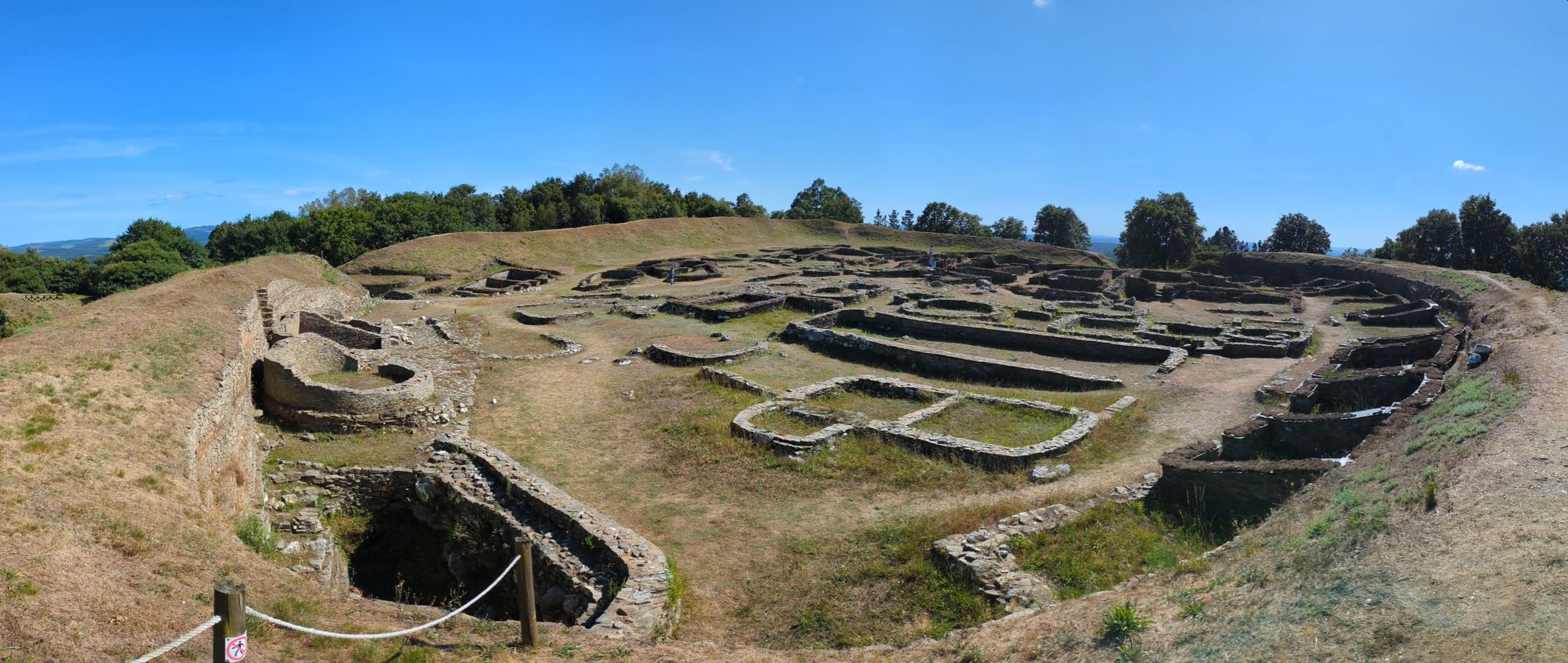
So a little history about this spot:
- Castro de Viladonga is one of Galicia’s best-preserved castros — the fortified hilltop settlements that are all over the north west corner of the Iberian Peninsula
- Formal archaeological work at Viladonga began in 1971, and the site has had an on-site monographic museum since 1983, displaying pottery, tools, jewelry, coins, and a scale model of the settlement and archeological digging continues to this day
- This work has established that this settlement has been in use since the 6th century BC, but most of the structures that remain are from 2nd - 5th centuries AD and were built during the Roman “occupation” and this is seen in the fusion between traditional round dwellings standing alongside rectangular buildings built in Roman style
- Castro culture was from around 800 BC - 100 AD and extended from Northern Portual, Galicia and Asturias
- Layout: circular or oval stone houses inside concentric earthen ramparts and ditches, usually on a hill or promontory
The actual eclipse
As I was in full panic mode due to the cloud cover I let the family know that we would be departing for Castro de Viladonga at 16:00 well in advance and repeated it multiple times as this normally is a time for resting after a large afternoon meal (ie siesta) and only through explicit and multiple reminders was I actually able to get us on the road by 16:00.
Phew.
Of course when we arrived, we were not the only ones to have thought of this location but we were able to find parking and I secured a spot on the actual circular wall, while the rest of the family looked for other possible viewing locations. I then tried to calculate if from said point I would actually see anything or not:
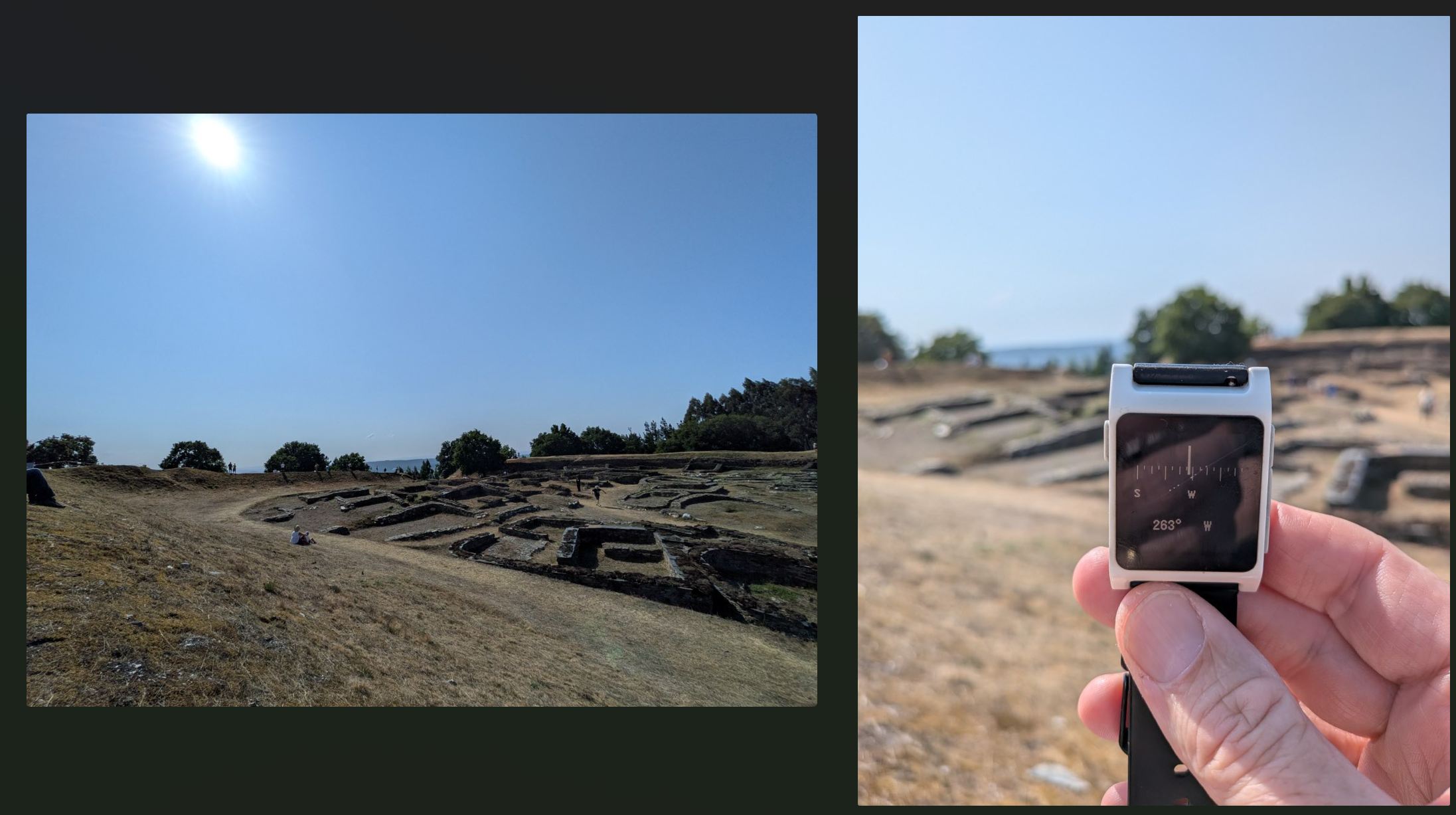
My rough calculations indicated it was a good spot, and quite historically cool, but the family found a better spot that was in the shade of a tree and that is where we ended up ready for the event:
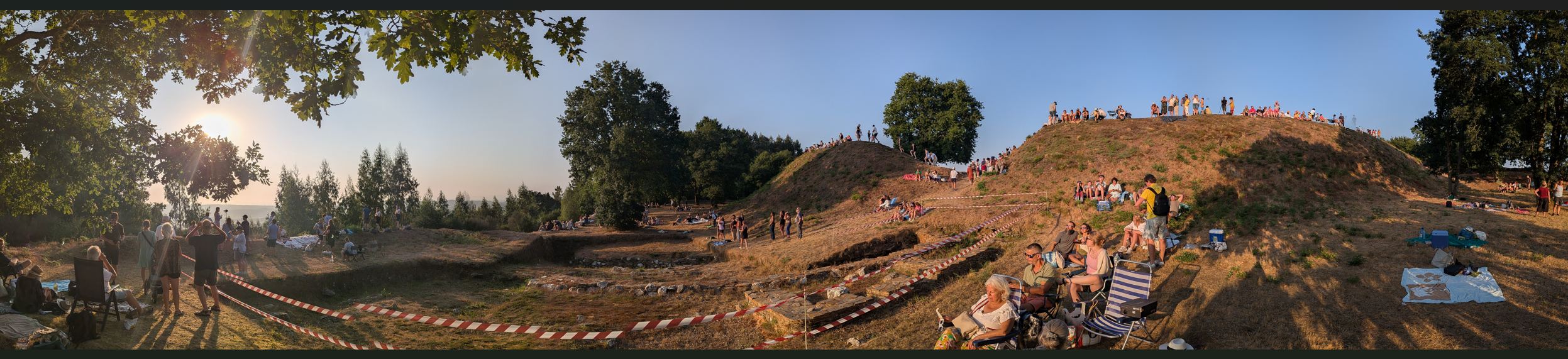
I knew that in order to have a secure “perfect” spot implied lots of down time waiting for the actual event, so I brought lots of cold beverages, snacks and entertainment in the form of a pinhole projector to also safely see the eclipse (disclaimer: my mother-in-law directed the creation of the projector):
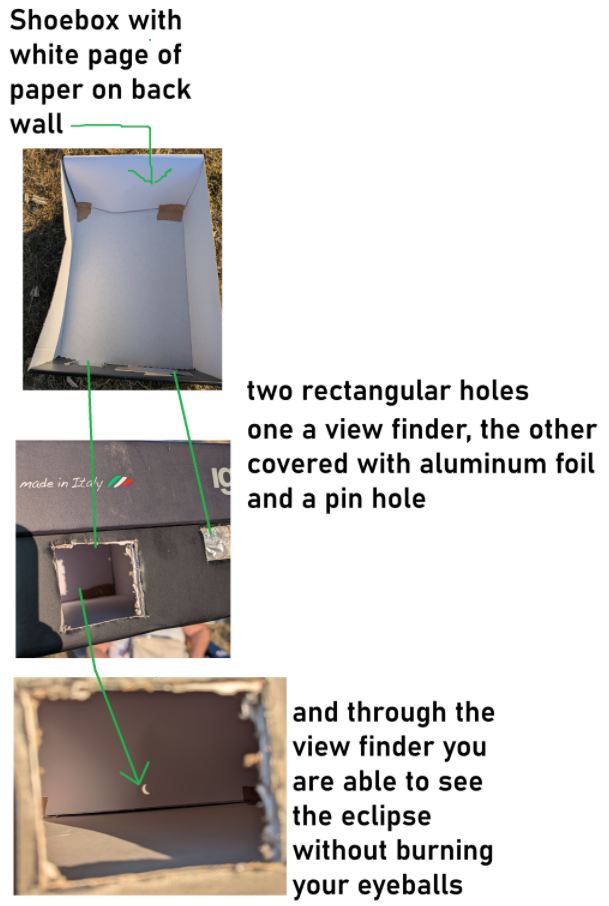
As the event approached more and more people arrived and here is the situation before I abandoned the hill side spot before joining the rest of the family in the shade:
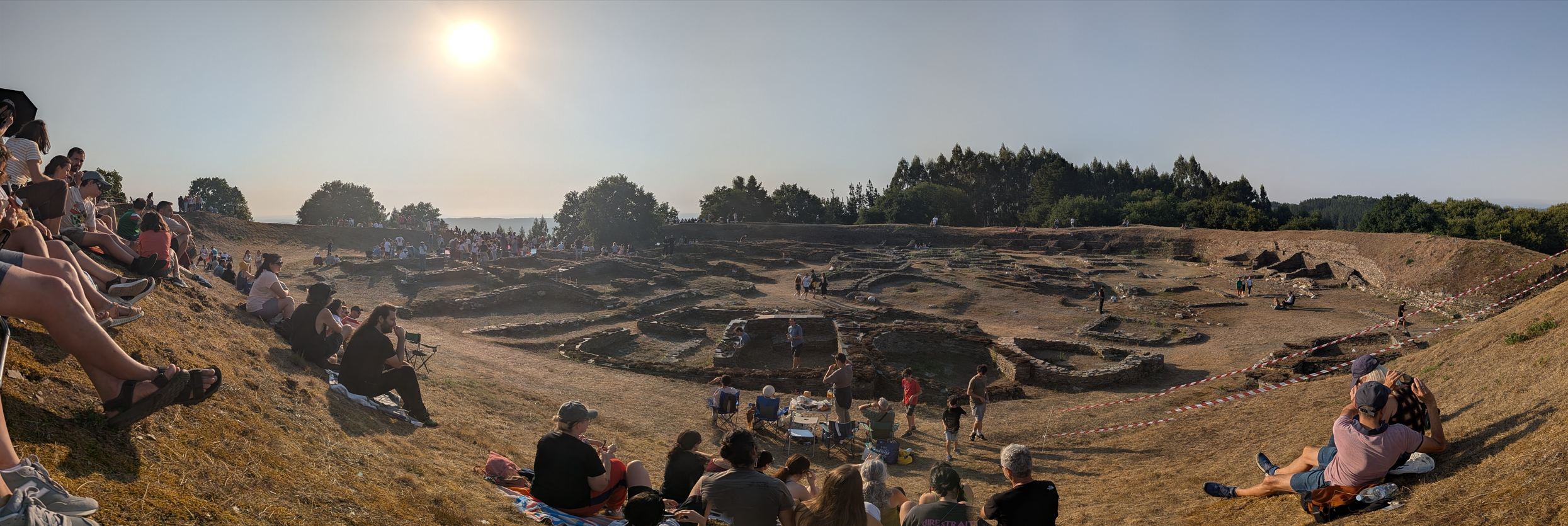
And then it got darker, and darker and suddenly all at once the sun turned off, the ISO 12312-2:2015 glasses came off, and OH MY what a treat. I understand how people become totality junkies traveling the world in search of another fix because that was one of the most intense minute and a half of my life. In addition to the arora, the coronal flare, there was a sunset in all directions and everyone one was just going crazy. Amazing. The difference between totality and partial is binary.
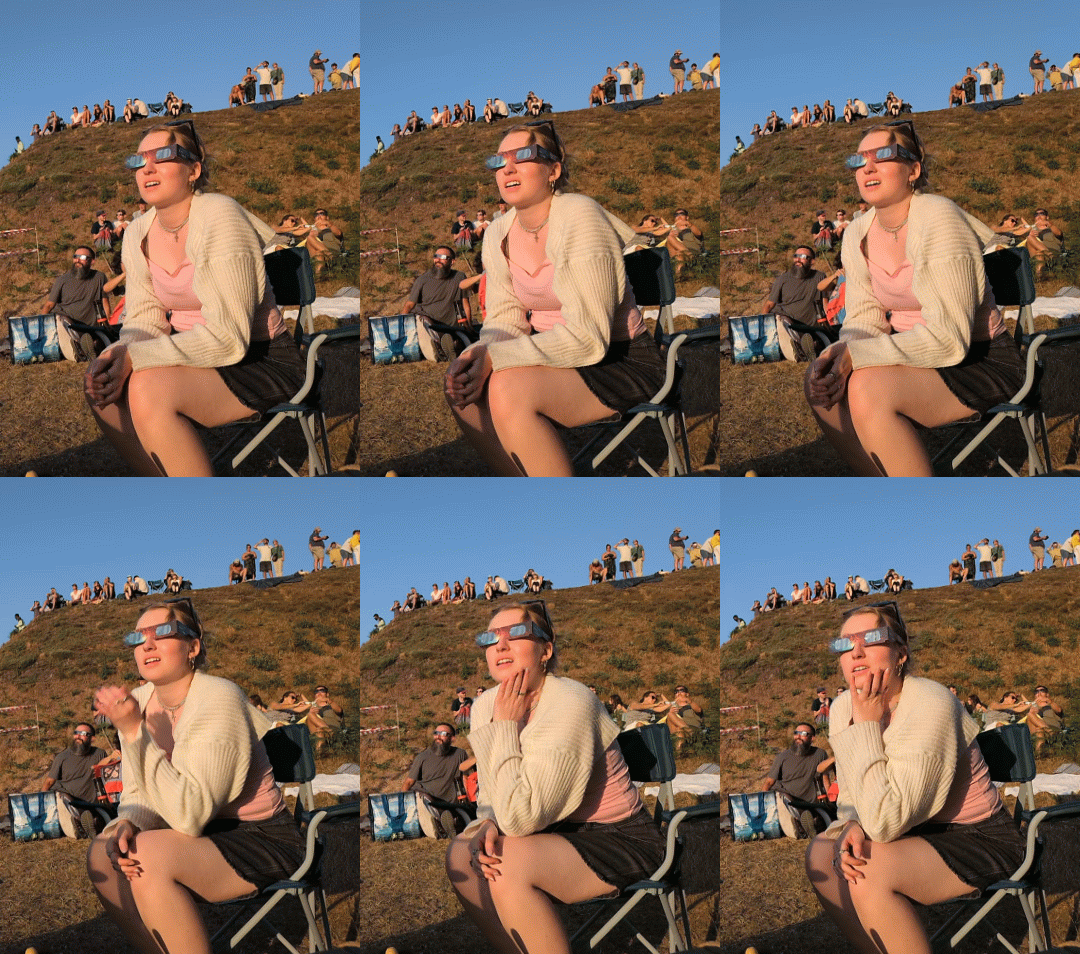
Reflections post eclipse
So now having seen totality I have to say there is a before and after. I felt I lived through a science fiction movie seeing the sun suddenly turn into a erie aurora with a fiery mass coronal ejection on the bottom right and this has gotten me thinking about how eclipses have affected human history. I mean, I was there waiting and ready with my ISO 12312-2:2015 glasses, but what about when this just happened out of the blue? And since when have humans been calculating and waiting for eclipses? So many questions that I turned to Claude for help:
- How many eclipses have there been in Castro de Viladonga since it has been inhabited (6th century BC)?
- going the statistical route: Any single point on Earth experiences a total solar eclipse roughly once every 375 years on average (this varies a lot — some spots go 1,000+ years without one, others get “lucky” clusters). Over ~2,600 years of Viladonga’s occupation, that statistical average would suggest somewhere in the range of 6-8 total eclipses
- Since when have humans been able to figure out and calculate an eclipse was coming?
- Babylonian astronomers discovered the saros cycle around the 7th or 8th century BC. By around 600 BC in Mesopotamia, Assyrian and Babylonian priest-mathematicians had scoured through the dates of past eclipses recorded on clay tablets, hoping to develop strategies for inferring when the next eclipse might happen. But they were not able to know where it would occur, or if it would be totality.
- The first precise prediction was done by Edmond Halley when he determined the exact 1715 total solar eclipse’s path
- How many times has a total eclipse just totally changed history?
- The Eclipse of Thales — May 28, 585 BC
During the Battle of Halysthe sky suddenly went dark mid-fight. Both sides took it as a sign the gods wanted the war over, put down their weapons, and negotiated a truce — ending a five-year war on the spot. - The Nineveh Eclipse — 763 BC
A cuneiform tablet from ancient Nineveh records “day turned to night,” preserved for over 2,700 years — the oldest reliably dated astronomical event in history, which modern historians now use as a fixed anchor point to date Assyrian kings, battles, and biblical events in the 8th century BC. - Einstein’s Eclipse — May 29, 1919
Scientists observing the total eclipse off the coast of West Africa measured the positions of stars near the sun and confirmed Einstein’s prediction that the sun’s gravity bends light — proof of general relativity. When results were announced at the Royal Society that November, it made front pages worldwide and Einstein became a household name overnight. Arguably the single biggest “science-changing” eclipse on record.
- The Eclipse of Thales — May 28, 585 BC
Thanks for reading and feel free to give feedback or comments via email (andrew@jupiterstation.net).