Collection of my notes on Eclipses
Interesting things about Eclipse
- What needs to happen for an Eclipse:
- Moon must be at new Moon (lunar eclipse) or full Moon (solar eclipse)
- Moon must be at one of its “nodes” (where the orbit of the moon crosses the orbit of the Earth’s orbit of the sun) so that either the moon will get between the sun and earth (solar eclipse) or the earth will get between the sun and the moon (lunar eclipse)
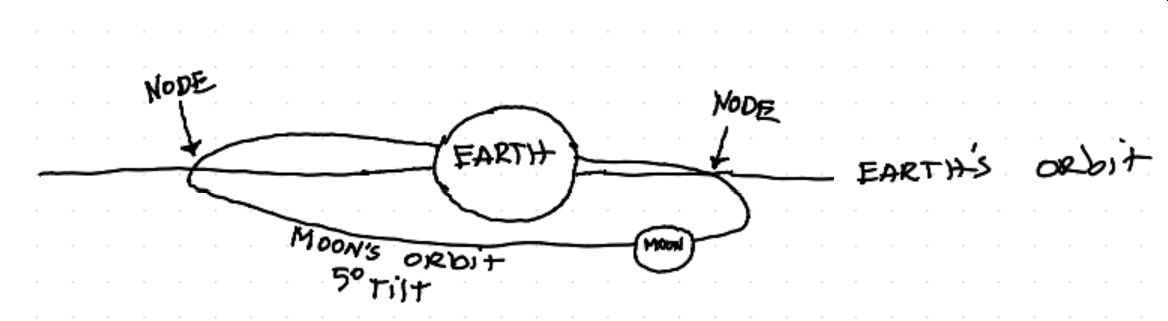
- The moon must be close enough to the earth on its orbit so that it will be large enough to cover the Sun’s face for a solar eclipse, or small enough to fit into the Earth’s shadow for a lunar eclipse.
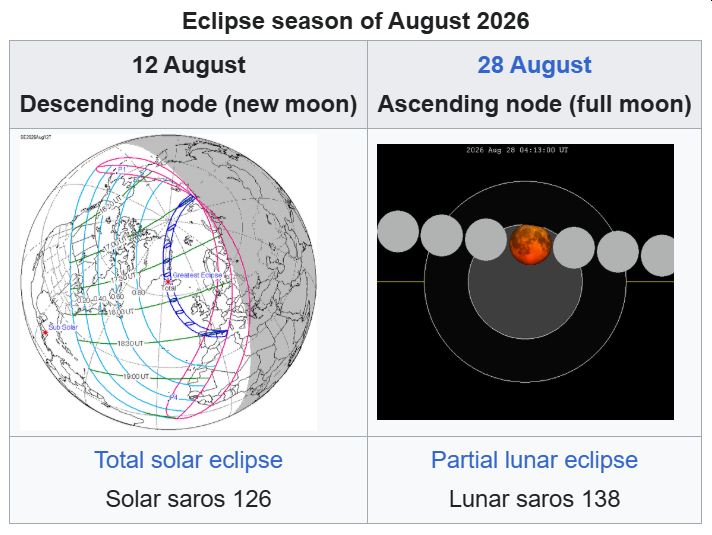
- Eclipse season: Just as there is rabbit and duck season I have learned there is eclipse season! It occurs roughly every 6 months when the orbital plane of the moon aligns just right to cause a solar eclipse during a new moon, and a lunar eclipse on the full moon.
- for example, after the total eclipse of that we had in Spain in 2026 there was then a lunar eclipse:
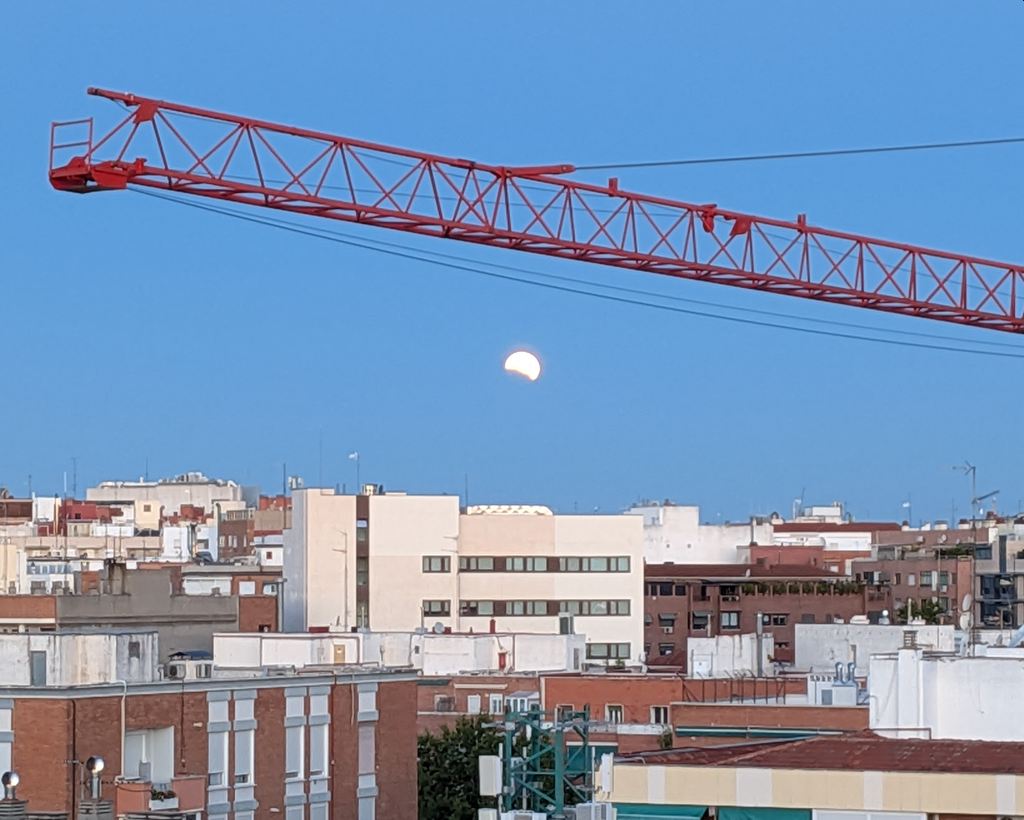
- Which is a funny story and actually led to this post: I went to the roof to do my morning exercises on Friday August 28th I saw the moon was missing a piece. I thought it must be because I did not have my glasses and went down and grabbed them and my phone and captured a picture and then later that night a neighbor explained there had been a lunar eclipse:
- for example, after the total eclipse of that we had in Spain in 2026 there was then a lunar eclipse:
- The August 12 2026 Eclipse was the first total eclipse visible from mainland Spain since 1905
- Any single point on Earth experiences a total solar eclipse roughly once every 375 years on average (this varies a lot — some spots go 1,000+ years without one, others get “lucky” clusters).
- Saros Cycle: a length of time covering 223 lunar cycles and can be used to to predict eclipses of the Sun and Moon.
- 6,585.32 days — 18 years, 11 days, 8 hours.
- Ancient Babylonian astronomers first discovered this repeating pattern in roughly the 7th–6th century BCE using centuries of careful observations recorded on clay tablets. Scribes noticed that if you laid out lunar eclipse dates in columns 223 months wide, the pattern lined up.
- The name was given by Edmond Halley in 1691 when he reintroduced the cycle and got the name from a Suda, a Byzantine lexicon of the 11th century.
Complicated things about eclipses
- Month comes from old english and is a combination of moon and measure. But there are different ways and things to measure and each has its own name:
Name Length What is measured Description Synodic
Month29d 12h 44m New moon → new moon Time to return to the same phase. Longest, because Earth has moved ~27° around the Sun and the Moon must chase it down. The calendar month — the basis of the Islamic, Hebrew and Chinese calendars. Anomalistic Month 27d 13h 19m Perigee → perigee Time between closest approaches to Earth. Longer than sidereal because the orbit’s long axis precesses forward (8.85-yr cycle). Governs supermoons, tidal range, and whether a solar eclipse is total or annular. Sidereal
Month27d 07h 43m Star → star The Moon’s true orbital period — one full 360° circuit against the fixed stars. This is the real orbit; every other month is this one seen through a moving reference frame. Tropical
Month27d 07h 43m Equinox → equinox Time to return to the same ecliptic longitude, measured from the vernal equinox. Just 7 seconds shorter than sidereal, because the equinox itself precesses over 25,772 years. Matters only for high-precision ephemerides. Draconic
Month27d 05h 06m Node → node Time to return to the same orbital node, where the Moon’s tilted path crosses the ecliptic. Shortest of the five, because the nodes regress to meet it (18.61-yr cycle). Sets the alignment condition for eclipses; named for the dragon that swallows the Sun. - The moon’s orbit is elliptical so at one extreme it is the farthest from the earth (called the apogee) and the other extreme closest to the earth (called the perigee).
- the crazy thing is not every apogee and perigee is the same amount but varies each time due the sun and earth’s influences (three-body problem)
Distance (km) When Minimum perigee 356,376 1912 Jan 04 ← closest Maximum perigee 370,354 1988 Dec 16 Minimum apogee 404,051 2069 Jul 26 Maximum apogee 406,711 1984 Mar 02 ← farthest Mean distance 384,400 — - and then gets even crazier: it’s lopsided: Perigee varies by 13,800 km. Apogee varies by only 2,600 km — five times less. I was unable to understand why. might have to revisit.
- the crazy thing is not every apogee and perigee is the same amount but varies each time due the sun and earth’s influences (three-body problem)
Links
- Solar eclipse of August 12, 2026
- Saros
- NASA: Eclipses and the Saros
- Eclipse season
- Eclipse cycle
- Lunar Phases, Months, and Eclipses
- NASA Eclipse Data (-1999 to +3000)
Change Log:
- 29/08/2026 First post
Thanks for reading and feel free to give feedback or comments via email (andrew@jupiterstation.net).