This morning Minerva (my OpenClaw AI Agent) included this in her morning report:
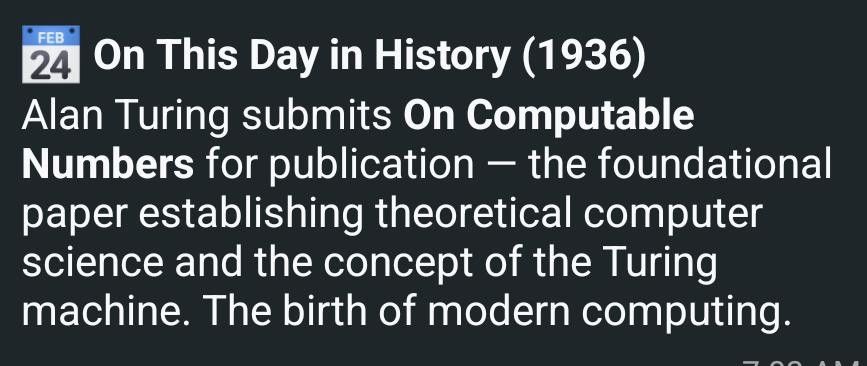
Interesting! Let check out this On Computable Numbers paper!
I found multiple copies of the paper but went with this PDF at the University of Virginia: Turing_Paper_1936.pdf and the first thing we are presented with is the full title:
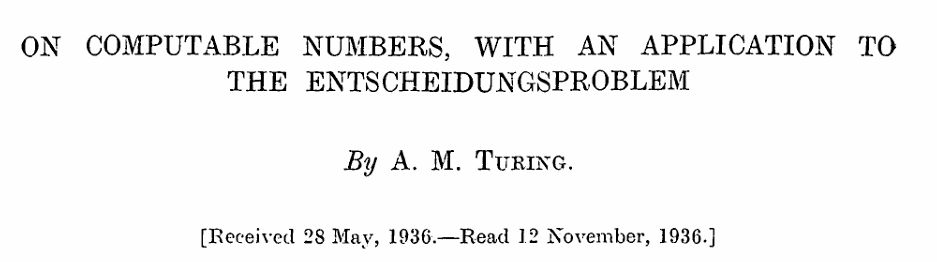
Which was not the first thing that caught my attention rather, what is this about being received in May and then read in November? How could they have such a back log in 1936 when there was still was no AI slop overwhelming every inbox and news feed? Well the reason is because the received date is when it arrived at the London Mathematical Society who then opened a peer review which lasted June - October, and then in November it was “read”, or formally presented to (and accepted by) the Society at regularly scheduled meeting. Alan Turning was 23 years old when he submitted the paper, and by the time of the reading he was 24, but was not present as has doing graduate studies at Princeton University.
The second thing that caught my attention was the lovely german erector set word Entsheidungsproblem which is decision+problem and refers to Hilbert’s 1928 challenge: is there a general algorithm that can determine whether any given mathematical statement is provable? And that is what this paper sets out to determine. I read the paper, or at least tried to read the paper but quickly got quite lost. So I of course asked my little buddy, in this case Gemini Pro, for help who broke it down as follows:
The most monumental part of the paper, and a foundational moment in the birth of modern computing, is Turing’s invention of a formal computational machine — and with it, a rigorous definition of what “computation” and “algorithm” even mean. This was a necessary prerequisite before he could prove that the answer to the Entscheidungsproblem is no: there is no general algorithm that can decide whether any arbitrary statement in first-order logic is logically valid.
On top of the computational machine, Turing introduced a universal computational machine — one capable of simulating any other computational machine by reading its description as data. Though Turing was doing pure mathematics rather than engineering, this is the fundamental concept underlying the stored-program, general-purpose computer: the program is simply data held in memory.
So thanks Alan and happy birthday modern computing!
Thanks for reading and feel free to give feedback or comments via email (andrew@jupiterstation.net).