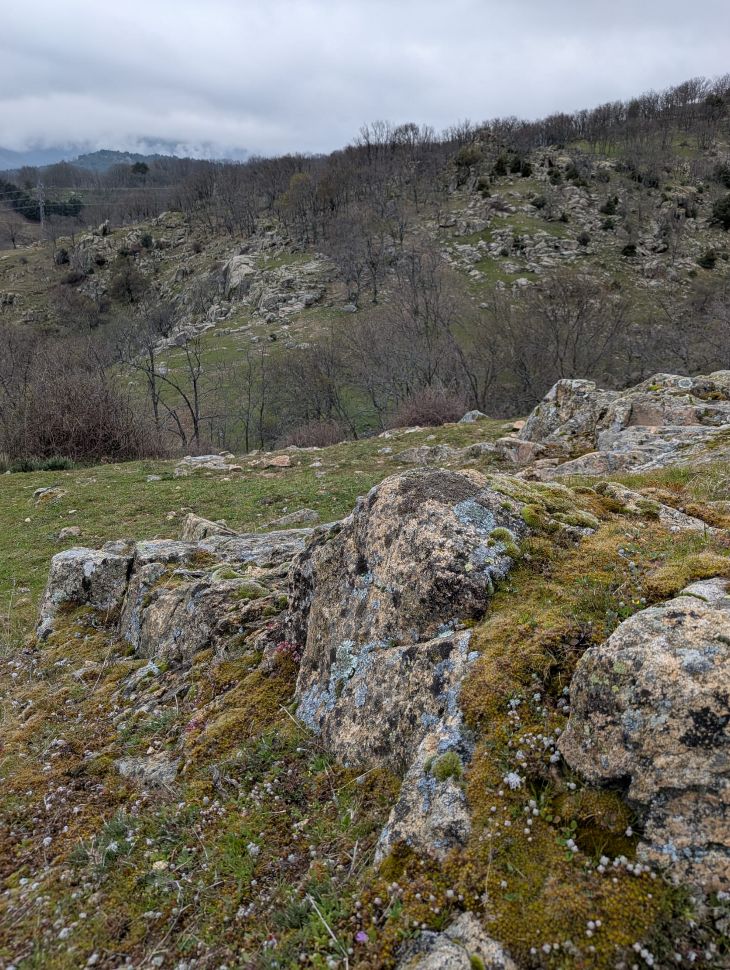
Today, the first day of Spring of 2026, was unfortunately cloudy and raining all day, but fortunately this afternoon there was a pause in the rain and we were able to take a walk to the Ermita de San Antonio. Possibly due to the sky being grey and our attention not bound to the horizon, we noticed that all the rocks are cover in splotches of all sorts of different colors. My wife commented that it was because the rocks in the the Sierra around Madrid have a lot of granite (correct) and I said I thought that it was due to lichen (also correct). Read on for what I learned once we got home and I began investigating!
Lichens
Lichens are not a single organism, rather a symbiotic partnership between two organisms:
- a fungus (the main structure)
- A photosynthetic partner—usually algae or cyanobacteria
The fungus provides the structure, protection, and ability to hold water.
The algae/cyanobacteria provide food via photosynthesis (they turn sunlight into energy).
Lichens are some of the oldest living things on the planet. Because they grow so slowly (some only 0.5mm to 1mm per year), a patch the size of your hand could easily be older than the United States. In the high mountains of Spain, some colonies are estimated to be over 1,000 years old.
Here in this closeup we can see what would appear to be all sorts of different species:
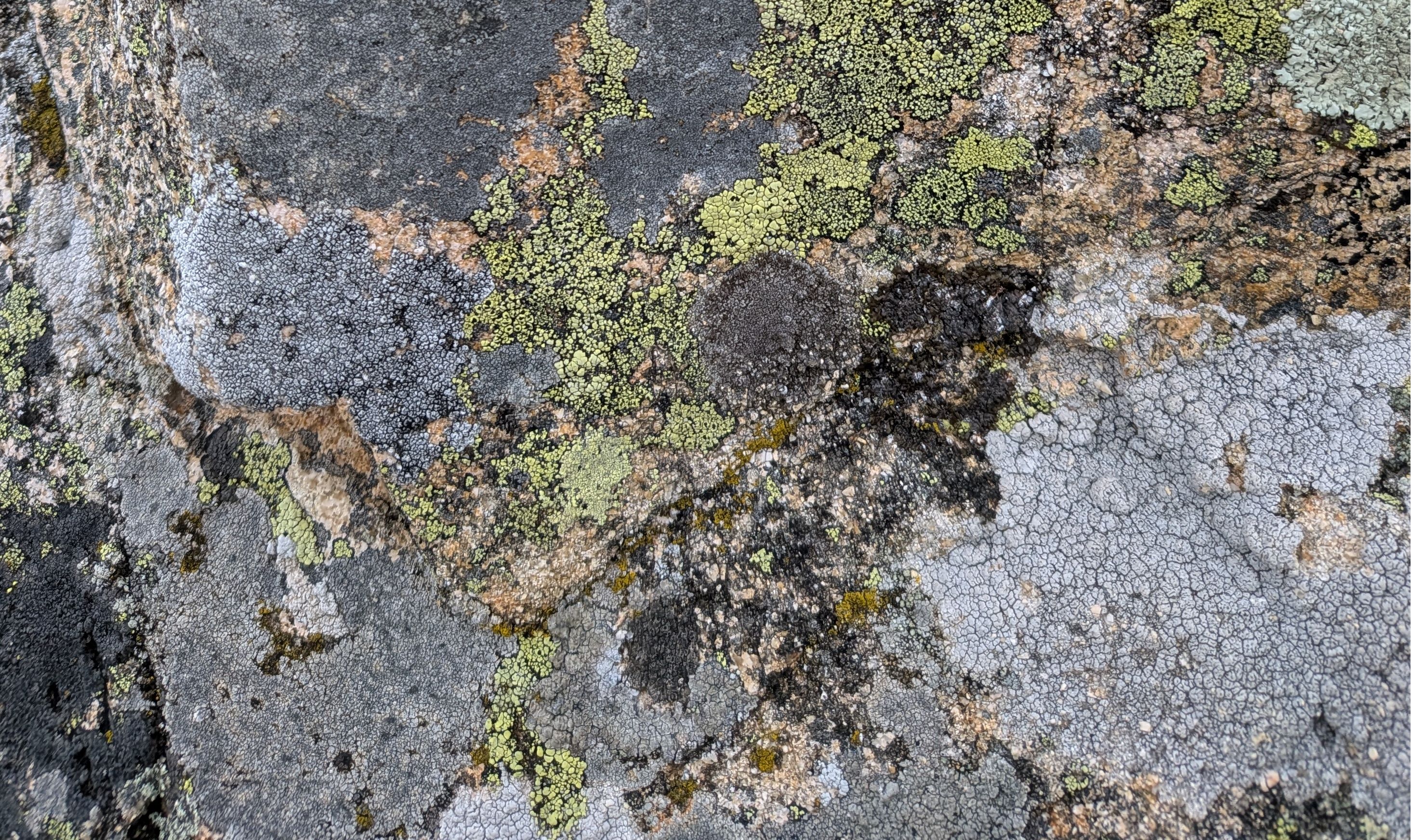
I asked multiple different AI’s to help identify the different species and each gave a different answer so I am hesitant to include any of it here.
What is clear is that the pinkish parts are the actual rock itself and it is known as Potassium Feldspar which is a type of granite.
So as I said at the start, both the misses and I were right so a good way to start spring!
Thanks for reading and feel free to give feedback or comments via email (andrew@jupiterstation.net).